Grand Canyon Lodging
Grand Canyon Lodging at the South Rim runs the gamut from historic landmarks brimming with old-world charm to modern facilities with contemporary décor and amenities – even some which effectively combine the two! Which one should you choose? That depends on several things, such as how soon you’re visiting, who you’re traveling with, and how much money you want to spend. Keep reading and you’ll soon have a better idea of which Grand Canyon hotel is the right place for your family.
Grand Canyon South Rim: In-Park
Want to be as close to the Grand Canyon as you possible can? You’ll want to stay inside the park, but you have to have the foresight to make your Grand Canyon vacation plans up to a year in advance. If that describes you, read on. If your trip is coming up within the next couple of months, skip to the section on Tusayan.
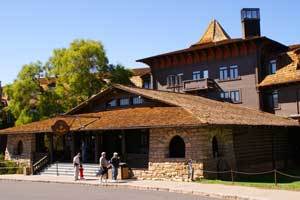
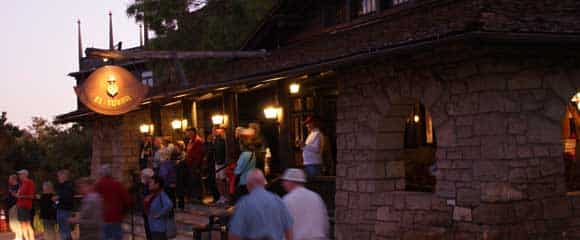
The El Tovar Hotel is the oldest and most famous Grand Canyon National Park hotel. Located mere feet from the South Rim of the Grand Canyon, this hotel was built and financed by the Atchison Topeka and Santa Fe Railroad upon completion of a spur line from Williams Arizona 60 miles South. When it first opened for business in 1905, the El Tovar was considered one of the most luxurious hotels in the Western United States. Administered by British-born hotelier Fred Harvey, the El Tovar would raise the bar on the standards of service of the day, with the prim and proper “Harvey Girls” leading the way in their black gowns and starched white aprons.
Designed by Charles Whittlesey, the railroad’s chief hotel architect, the El Tovar was described in promotional literature of the time as “a combination of a Swiss chalet and a Norwegian villa.” Featuring peeled log beams, vaulted ceilings and large entry porches, the El Tovar’s atmosphere evokes the feeling of a time gone by, when a Grand Canyon vacation lasted for weeks, months, or perhaps an entire season. Today, the hotel continues to honor the tradition of old-style hospitality, with 78 elegantly decorated rooms, a dining room regarded as one of Northern Arizona’s best restaurants, a cocktail lounge with a porch overlooking the canyon, room service, evening turn-down service, newsstand and a concierge desk to help visitors arrange Grand Canyon tours and other activities. The gift shop houses one of the park’s finest collections of Native American jewelry, including prize-winning entries at the prestigious Inter-Tribal Indian Ceremonial in Gallup, New Mexico.
The El Tovar hotel’s reputation precedes it to all corners of the globe. Consequently, it’s not unusual for it to be completely booked up to a year in advance. Standard rooms have double or queen beds; deluxe rooms have queen or king beds; there are also several spacious, beautifully appointed suites. The El Tovar Hotel is an excellent choice for those wanting to stay on the Grand Canyon rim, and who wish to experience Grand Canyon lodging as it was back in the “olden days.” Due to its popularity, it is best for visitors who are planning their vacations well ahead of time. It’s a wonderful place for couples celebrating a special milestone like a honeymoon (first or second!) or anniversary. It’s hard to imagine a place like the El Tovar as having any drawbacks, but there are some: the biggest one is that the hotel does not have a swimming pool. Activities in the area are also limited, especially after sunset (though the hotel does have cable TV). Families with young children may want to choose Grand Canyon lodging elsewhere for these reasons. All rooms are air-conditioned.
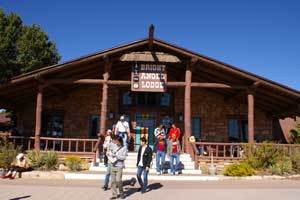
The Bright Angel Lodge, the second oldest lodge at the Grand Canyon, was designed in the 1930’s. After the establishment of the El Tovar Hotel, which served upscale travelers who arrived on the Grand Canyon train, the need soon arose for more economical rimside accommodations to serve the visitors that were now arriving by car. For the design of the new lodge, the Fred Harvey Company turned to an old friend: Mary Jane Elizabeth Colter. One of America’s first female architects to rise to prominence in the New West, Colter was no stranger to the Grand Canyon: she had designed the “Hopi House” adjacent to the El Tovar hotel and the Watchtower at Desert View. Her buildings, reflecting Native American and Spanish influences, did not appear to be just randomly plunked down on a plot of land; instead, they seemed to be born out of the landscape as if they belonged there.
Like many of Colter’s designs, the lobby of Bright Angel Lodge features creative, almost free-form stone masonry, rough-hewn log beams, and cozy fireplaces, including one that represents each geologic layer of the Grand Canyon, from bottom to top. The rooms themselves are a mix of quaint cabins with private baths, and European-style rooms with shared baths. Two of the rimside cabins actually date back to the late 1800’s: the Bucky O’Neill Suite and the Grand Canyon Park’s old post office! The Bright Angel Lodge is located near the Bright Angel Trailhead, which is the starting point for the world-famous Grand Canyon mule rides, and Grand Canyon hikes.
Other services offered by Bright Angel Lodge include a coffee shop, steakhouse (the Arizona Room), cocktail lounge, gift shop, seasonal ice cream parlor and a tour desk where guests can arrange Grand Canyon tours and inquire about other activities in the area. There is also a Fred Harvey History Room located near the front desk where visitors can peruse such curiosities as an El Tovar dinner menu dating back to the early 1900’s, or a tea set designed by Mary Colter herself.
Because of Bright Angel Lodge’s economical prices (some of the least expensive lodging at the Grand Canyon can be found here) and prime location (steps from the canyon rim), it also tends to fill quickly. Its proximity to the Bright Angel Trailhead makes it a popular choice for hikers. Since a majority of the rooms at Bright Angel Lodge have only one bed, it is best suited to couples and solo travelers. Larger groups or families should probably pass on this one, unless you’re fortunate enough to be able to reserve one of the few suite type rooms. Before choosing one of the less expensive lodge rooms, remember that you will have to walk down the hall to take a shower. If you prefer a private bath, choose one of the cabins. Most of the rooms at Bright Angel Lodge do not have TV’s, and again, there is no swimming pool (none of the in-park hotels have them). Most rooms are air-conditioned.
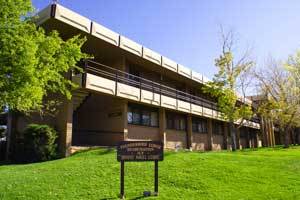
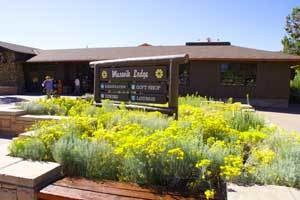
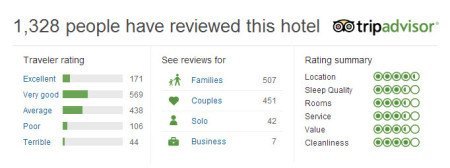
Maswik Lodge, formerly (and briefly) known as Mushwhip Lodge, dates back to the 1960’s. At this point in history, it was obvious that the automobile had all but replaced the train as the vehicle of choice for Grand Canyon vacationers, and that meant that more rooms were needed for the hordes of American families who sought accommodations in the park every day. Maswik Lodge fulfilled that need with a 150-room complex comprised of two-story wood and stone buildings situated 1/4 mile from the canyon rim. Nestled amongst stands of Ponderosa pines in the Kaibab National Forest, guests at Maswik Lodge often report waking to the sight of deer or elk grazing outside their windows.
Maswik Lodge is one of several family-friendly Grand Canyon motels. Featuring two queen beds in each room, and sufficient space for rollaway beds, Maswik Lodge is divided into two sections: the newer, more spacious Maswik North, and Maswik South, which predates the North section by a few years and has somewhat smaller rooms. All rooms have the standard hotel amenities such as private bath, TV, telephone, in-room coffee and refrigerators. Internet kiosks are available for a nominal fee inside the lobby. Maswik Lodge has a cafeteria open from 6 AM to 10 PM, gift shop, sports bar with a wide-screen TV and a tour and transportation desk where visitors can arrange Grand Canyon helicopter flights, Motorcoach tours and other local activities.
Maswik Lodge is just a five-minute walk from the Grand Canyon Rim. It is an excellent choice for most everyone, especially families with children or larger traveling groups. Wheelchair accessible accommodations are also available. Advance reservations are strongly recommended. Maswik Lodge is one of two in-park hotels that offer off-season discounts December through February (exclusions apply). Most of Maswik Lodge’s rooms are air-conditioned; no swimming pool.
In addition to Maswik Lodge, the 1960’s saw the arrival of “twins” to the Grand Canyon hotel family: Kachina and Thunderbird Lodges. Though not exactly identical, they do bear a strong resemblance to one another with distinctive concrete panel accents and flat roofs. Inside, the amenities offered by these two rimside lodges are the same: two queen beds (limited number of king rooms), in-room coffee, refrigerator, safe, TV, telephone and private bath. All rooms are air-conditioned
Kachina and Thunderbird Lodges do not have food and beverage facilities or other services on-site. Thunderbird Lodge has a banquet room available for use by private arrangement. Check-in for these lodges is at El Tovar Hotel and Bright Angel Lodge respectively. Advance reservations are strongly recommended.
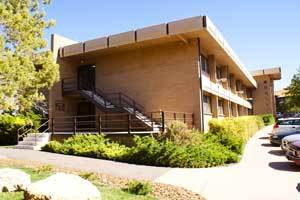
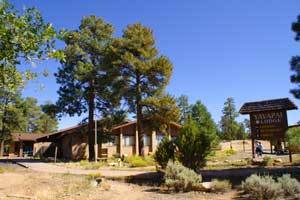
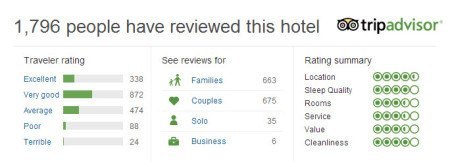
Yavapai Lodge, the sixth (and last) Grand Canyon lodge, takes its name from a Native American tribe. It is pronounced like “have a pie.” Completed in 1972, Yavapai Lodge is the largest of the South Rim Grand Canyon hotels. Like Maswik Lodge, it is divided into two sections: Yavapai East, featuring larger rooms in two-story buildings and Yavapai West, with smaller rooms in single story cinder-block buildings. The complex is situated 1 mile East of the Grand Canyon Village Historic District and 1 mile South of the Grand Canyon rim.
Accented by Ponderosa pine, Juniper and other unique desert plants, Yavapai Lodge is geared toward families with rooms featuring two queen beds (Yavapai East has a limited number of rooms with one king), TV and phone. At Yavapai East, parking is available adjacent to lodge buildings; Yavapai West guests can park directly in front of their door. Yavapai East rooms are air-conditioned, and have refrigerators and in-room coffee; Yavapai West rooms are not air-conditioned but do have ceiling fans. Winter value rates are also offered at Yavapai Lodge from December through February.
Other services available at Yavapai Lodge include a cafeteria, gift shop, and tour and transportation desk where visitors can arrange to take part in activities such as Grand Canyon tours, ranger programs and more. Yavapai Lodge is also located near the “Market Plaza,” which consists of a bank, post office and general store. The Grand Canyon park visitors’ center is located within ½-mile of the lodge as is a Laundromat.
All in-park accommodations at Grand Canyon South Rim are non-smoking and do not accept pets. All above-referenced hotels are administered by Xanterra South Rim LLC. For reservations and information, www.grandcanyonlodges.com or call 1-888-297-2757 (toll free in US) or 1-303-297-2757 (International Toll).
Grand Canyon South Rim: Tusayan
Not all Grand Canyon visitors will be able to secure lodging inside the park – in fact, most Grand Canyon visitors won’t. But depending on your circumstances, that might not be your best option anyway. Read on to see why you should consider booking your Grand Canyon hotel in Tusayan, just minutes from Grand Canyon South Rim:
The Red Feather Lodge was the first hotel built in Tusayan in 1963. During the mid-1990’s it was briefly acquired by a national hotel chain who financed the construction of a new wing of rooms. Today, the property is once again independently owned and operated and is divided into two sections: the “motel” section, which is in the older part of the complex, and the newer “hotel” section. Most rooms have two queen beds; a limited number of rooms with one king are available. On-site amenities include a seasonal heated outdoor pool, Jacuzzi, and activity desk for booking Grand Canyon tours. Room rates include continental breakfast and wireless internet access. The Café Tusayan is located adjacent to the property serving breakfast, lunch and dinner. Box lunches are also available by prior arrangement for hikers.
The Red Feather Lodge is the Grand Canyon area’s only pet-friendly hotel, and one of only a few hotels in the area that still offer smoking rooms. It is located just two doors down from the National Geographic IMAX Theatre, and just one mile from the Grand Canyon Airport.
The Best Western Grand Canyon Squire Inn was built in the early 1980’s to cater to the needs of the modern traveling family, boasting the most on-site amenities of all hotels in the Grand Canyon area. The Best Western Grand Canyon Squire Inn has not one but three food and beverage establishments: a coffee shop, fine dining restaurant and a snack bar; it has both a cocktail lounge and a sports bar. The Best Western Grand Canyon Squire Inn has all the attributes you would expect from a contemporary Grand Canyon hotel such as a seasonal outdoor pool, Jacuzzi, sauna, workout room, and gift shop, but it also has a few things you may not expect: a beauty salon, cowboy museum and a family fun center including a 6-lane bowling alley, video arcade and billiard tables.
Rooms at the Best Western Grand Canyon Squire Inn are primarily standard and deluxe rooms. All are air-conditioned. A limited number of suites are available. Room rates include continental breakfast and wireless internet access. Deluxe rooms feature mini-fridges. The Best Western Grand Canyon Squire Inn is an all non-smoking hotel.
The Best Western Grand Canyon Squire Inn is located a short walk away from the IMAX Theatre. It is also located less than one mile from the Grand Canyon Airport, making it a great choice for those going on many Grand Canyon tours. With all the family-friendly amenities the Best Western Squire Inn has to offer, it also fills up quickly. But if you can’t get reservations here, remember that you’re always welcome to come over and partake of the facilities at the Squire any time you wish.
The Canyon Plaza Quality Inn & Suites also dates back to the 1980’s and was designed as a contemporary resort hotel with upscale touches such as marble floors and an inviting indoor atrium. Its guest rooms are generously sized, air-conditioned and consist of standard and deluxe rooms and suites. Room rates include continental breakfast, high speed internet access and in-room entertainment including cable TV, and access to video games and pay-per-view movies.
On-site amenities include gift shop, seasonal outdoor pool, hot tub and an indoor Jacuzzi. For dining, JJK’s Restaurant gives guests a choice of an extensive buffet or a coffee-shop style menu, as well as the Wintergarten cocktail lounge open seasonally.
The IMAX Theatre is located right next door to the Quality Inn, and other restaurants and shops are within easy walking distance. The Grand Canyon Airport is located 1 mile South of the hotel. Airport shuttle service is available by prior arrangement. Some smoking rooms are available, pets are not allowed.
The Holiday Inn Express is one of the area’s newer properties, built in 1995, and renovated in 2006. It is definitely a family-friendly Grand Canyon hotel, with a special feature you won’t find at any other Grand Canyon lodge: KidSuites®! These imaginatively designed “rooms within rooms” include bunk beds (or two single beds), play table, 19” TV with DVD player and a video game system such as Nintendo or Sega. The Grand Canyon Holiday Inn Express has 160 air-conditioned guest rooms with two queen or one king bed, and 32 suites, including several “theme” suites that pay tribute to Western luminaries such as author Zane Grey and the legendary Mother Road, Route 66. Room rates include continental breakfast, which has been highly rated on sites such as TripAdvisor.com
On-site facilities include an indoor pool and Jacuzzi. There is no restaurant on-site, but there are several dining establishments within easy walking distance of the Holiday Inn Express. The Holiday Inn Express is 3 doors down from the IMAX Theatre, and 1 mile from the Grand Canyon Airport. The Holiday Inn Express is a 100% non-smoking hotel; pets are not allowed.
The Grand Hotel holds the distinction of being Tusayan’s newest hotel, though its atmosphere is inspired by the area’s oldest. Built in 1998, the Grand Hotel pays “architectural homage” to the El Tovar Hotel, with peeled log beams, vaulted ceilings, and free-form stone masonry. Its 120 air-conditioned guest rooms are large and inviting, decorated in contemporary Southwestern color schemes. Room classifications are standard, deluxe and suites, with bedding configurations of two queens or one king. Deluxe rooms feature patios, and the suites offer plasma screen TV’s. All rooms have pillow-top mattresses, Bath & Body works toiletries, in-room coffee and cable TV.
On-site amenities include an indoor heated pool and Jacuzzi, complimentary wireless internet in the lobby, fitness center, and a Laundromat. The Canyon Star restaurant serves breakfast, lunch and dinner, and the adjacent Saloon often has nightly entertainment such as live country music, karaoke or Native American dancers. And if you think you had to leave your daily Starbuck’s fix back home, think again: the Grand Hotel has a Starbuck’s coffee counter on-site. The Grand Hotel is also 100% smoke-free, and pets are not allowed.
To make reservations at any of the above Grand Canyon Arizona hotels in Tusayan, call 1-800-916-8530 or visit http://www.grandcanyon.com/hotels.html
Grand Canyon South Rim: Gateway Community Hotels
If you’re unable to get lodging for your Grand Canyon trip inside the park or in Tusayan, all is not lost. You’ll just need to do a bit more driving at the end of your Grand Canyon sightseeing day. Look to the Grand Canyon’s gateway communities for your lodging needs.
Valle
Located approximately 30 miles South of Grand Canyon Village is a small community called Valle, which is home to the Grand Canyon Inn. Founded in the 1950’s by a Canadian family, the Grand Canyon Inn bounced between a few different spots before settling on its present location. Today, it has over one hundred rooms featuring two queen beds, full bath, satellite TV and phone with data port. Both non-smoking and smoking rooms are offered. No pets.
On-site amenities include a seasonal outdoor heated pool, restaurant, and the Valle Travel Stop, which includes a Chevron gas station, convenience store, ATM, fast food court, and a gift shop with an impressive inventory of Native made crafts. The Valle Travel Stop is an official National Park Service Pay Station, which means you can save time at the entrance gate by pre-purchasing your park entrance fee here, and they’ll even give you a free Grand Canyon map. For more information or to make reservations at the Grand Canyon Inn, call 1-800-635-9203 or visit www.grand-canyon-inn.com
Cameron
Located approximately 60 miles East of Grand Canyon Village is a place that’s nothing less than a local institution: the Cameron Trading Post. A stay at the Cameron Trading Post is not your run-of-the-mill Grand Canyon park sojourn; it is a cultural experience, too. The Cameron Trading Post is situated on the Navajo Indian Reservation. It has been in business since 1916 when brothers C.D. and Hubert Richardson established it as a vital commerce center for the Navajo, Hopi and Paiute Indians that resided in the area and traded their hand-made goods for food staples and other supplies.
Decades later, as the Navajo Indian Reservation became an international tourist destination, a small hotel, gift shop and restaurant were added to the trading post complex. The gift shop houses one of Northern Arizona’s most comprehensive and beautiful assortments of Native American arts and crafts. The restaurant also garnered a far-reaching reputation, with people willingly driving for hours just to have a taste of their house specialty, the “Navajo taco,” a hearty dish consisting of beans, meat, cheese, chile peppers, lettuce, tomatoes, sour cream and salsa piled high atop a piping hot slab of chewy Navajo fry bread.
In the mid-1990’s, the hotel and gift shop were remodeled and expanded. The hotel rooms at the Cameron Trading Post are some of the most inviting in the area, with hand-carved furniture and authentic Southwestern art decorating each one. Rooms offer one or two queen beds, and a small number of suites are available. Each room offers cable TV, phone, wireless internet access, in-room coffee, heating and air-conditioning. Pets are accepted with a non-refundable deposit; all rooms are non-smoking. For more information or to make reservations, visit www.camerontradingpost.com. or call 1-800-338-7385.
Williams
Williams, Arizona is located approximately 60 miles South of Grand Canyon National Park. Named for trapper Bill Williams, Williams Arizona began its existence as a rip-roaring frontier town. Later, it became a part of the legendary Route 66. Today, Williams is probably most famous for something that it almost lost: the Grand Canyon Railway.
In 1901, the Atchison, Topeka and Santa Fe Railroad completed a spur line from Williams that extended all the way to the South Rim of the Grand Canyon. Until that point, the journey to the Grand Canyon rim was a whiplash-inducing stagecoach ride that took days. With the arrival of the train, the trip was reduced to mere hours, and awaiting disembarking passengers at the canyon’s edge was the crown jewel of National Park hotels, the most luxurious of her day: the magnificent El Tovar.
For almost five decades, the railway was the preferred mode of travel to the edge of the great chasm. Steam engines would be replaced by diesel engines in the 1950’s, making the journey even shorter. But eventually, the shining locomotive lost its luster, its popularity eclipsed by private passenger cars. In 1968, a mere three passengers enjoyed the last commercial train ride to Grand Canyon National Park. In 1969, the Williams train depot closed, and the glory days of the Grand Canyon train were proclaimed “over.”
But that proclamation turned out to be a bit premature. Nearly twenty years later, a familiar steam whistle was heard once again echoing through the Ponderosa pines as the Grand Canyon Railway roared back to life. With financiers Max and Thelma Biegert at the helm, the old iron horse made its re-inaugural run to the Grand Canyon on September 17th, 1989, 88 years to the day after the arrival of the first passenger train in 1901. The Grand Canyon Railway is back to stay, and it is bigger than ever as thousands of passengers annually relive the historic journey complete with Wild West shoot-outs, cowboy singers and even a “train robbery!”
Williams is also the origin of another activity that has become popular just in recent years: the Inner Canyon Jeep Tour. This exciting expedition through living history, which is offered year-round, takes you all the way to the bottom of the Grand Canyon! A full day’s worth of adventures, this 8-hour tour will show you the Route 66 of Seligman, which was the real-life basis for the fictional town of Radiator Springs in Disney/Pixar’s movie “Cars.” You’ll also descend to the depths of the earth as you explore the Grand Canyon Caverns, then riding a safari jeep to the bottom of the Grand Canyon on Hualapai Indian Tribal lands.
Other favorite activities in Williams include horseback riding, carriage rides, visits to the Grand Canyon Deer Farm, and leisurely strolls down old Route 66 to see vintage cars and 1950’s era memorabilia. With such a fascinating history, family-friendly activities, and relatively close proximity to the Grand Canyon, Williams would make an excellent base for your Grand Canyon lodging, especially if you’re looking to save money. There are approximately 30 motels and hotels to choose from, both chain and independently owned, most of which are very reasonably priced.
For reservations and information and Grand Canyon Williams lodging, call 1-800-916-8530 or visit http://www.grandcanyon.com/williams-hotels.html
Flagstaff
In 1855, a road survey crew camped on the outskirts of the Coconino National Forest cut the limbs off a Ponderosa pine tree and hoisted the American flag atop it, and thus, a town was named. Flagstaff, Arizona, located 85 miles Southeast of Grand Canyon National Park, first established its identity on earthy pursuits such as logging and ranching. But its tall mountains and dark, clear nights soon caught the attention of people who devoted their lives to watching the skies. In 1894, astronomer Percival Lowell chose Flagstaff as the site of a new observatory which would later bear his name, and garner worldwide fame for the discovery of Pluto (1930) and the mapping of the moon for the Apollo expeditions in the 1960’s.
Flagstaff in fact has a long history of attracting people of diverse backgrounds and interests, going back hundreds of years before it officially became a town. About 800 years ago, The Sinagua and Cohonina Indians lived and farmed in an area now known as Walnut Canyon National Monument. Remnants of their dwellings, built into the cliffside of a steep, winding canyon, can be visited via the Island Trail (preferably by those lacking a fear of heights!). Several miles North, the Wupatki National Monument contains several well-preserved remnants of a pueblo that served as a trade and commerce center for several different Native groups that resided in or traveled through the area. This monument, and adjacent Sunset Crater, can be enjoyed via a short loop drive and relatively easy walking trails. The Museum of Northern Arizona honors Flagstaff and the surrounding area’s Native heritage by housing an extensive collection of antiquities and artifacts representing many Southwestern tribes. While its connection to the past is well-documented, Flagstaff also has a vested interest in the future, as the home of Northern Arizona University.
Other activities and attractions in the Flagstaff area include but are not limited to the Riordan Mansion, a homestead designed by El Tovar architect Charles Whittlesey; the Arboretum, a 2,500 acre botanical garden and environmental learning center; the Pioneer Museum, a comprehensive exhibit of artifacts and implements from the 19th century; and the Arizona Snowbowl, which offers downhill skiing (yes, you can ski in Arizona!) during the winter, and a scenic skyride during the summer.
Flagstaff is a popular lodging choice for many Grand Canyon visitors, especially those taking a “hub and spoke” approach to their vacations. This type of traveler would use Flagstaff as a “base camp” and take day trips to not only the Grand Canyon, but to outlying attractions such as Lake Powell, the Painted Desert, Petrified Forest, Meteor Crater, Sedona and more. Flagstaff offers a wide variety of hotels, motels, and bed and breakfast type facilities, with prices ranging from economic to upscale.
For more information on Grand Canyon Flagstaff lodging, call 1-800-916-8530 or visit http://www.grandcanyon.com/flagstaff-hotels.html
Page – Lake Powell
In 1957, erstwhile President Dwight D. Eisenhower pressed a button that set off a dynamite blast, signaling a new era in the development of the American West. Designed and financed by the Bureau of Reclamation, the Glen Canyon Dam would impound the waters of the Colorado River behind it, forming a massive lake that promised to transform barren deserts into fertile farmland, and never-ending sand into bustling cities. Upon completion, the mighty coffer would stand a mere six feet shorter than the Hoover Dam, which required the sweat and strength of thousands of workers. The workers lived on a mesa-top near the construction site, in a hastily assembled “camp” comprised of mostly temporary structures such as trailers, Butler buildings and Quonset huts. The ragtag settlement was named “Camp Page,” in honor of a former commissioner of the Bureau of Reclamation.
Fast forward to late 1960’s: the Glen Canyon Dam was finished, and the lake – called Lake Powell – was rapidly rising, and earning a reputation as one of the most scenic man-made waterways in the world. The “camp” on the mesa was no longer a camp. It was now a full-fledged town, and an international tourist destination. Though the young city now had a new identity, it still kept a part of its old name, and was now known as “Page, Arizona.”
One of Page’s early “cottage industries” made use of Army surplus pontoon rafts left over from a government expedition through the Grand Canyon. These would become the mode of transport for thousands of families to enjoy the 15-mile stretch of the Colorado extending from the base of the Glen Canyon Dam to Lees Ferry in what is now one of Arizona’s most popular tours: the Colorado River Float Trip. With no rapids but lots of incredible scenery, this trip makes the Colorado River accessible to almost anyone who wants to experience it.
Another of Page’s “natural assets” are geological oddities known as slot canyons. Resembling a cave without a roof, these narrow, vertical canyons number in the dozens throughout Northern Arizona and Southern Utah. Three of the world’s most famous slot canyons are located within a short drive of Page: Antelope Canyon, Waterholes Canyon and Canyon X. Formed over millions of years by flash floods, winds and blowing sand, these swirling, convoluted formations have an ethereal look and feel which is augmented at mid-day when sunbeams penetrate the ceiling and shine down onto the canyon’s floor. This is seen most dramatically at Upper Antelope Canyon, which can be explored easily on a 4-wheel drive tour offered by four different outfitters in the Page area.
Boat tours on Lake Powell present yet another avenue for exploring the myriad rock formations and canyons present in the area. Perhaps the most famous of Lake Powell’s attributes is best seen in this manner: Rainbow Bridge. First seen by Anglo-Americans in the early 1900’s, Rainbow Bridge is the largest known free-standing stone arch in the entire world, soaring to a height of nearly 300 feet above the ground. In the old days, the journey to the bridge was a “toilsome” trip that took days, sometimes weeks, on foot or horseback. In the 1950’s, jetboat technology reduced the trip to a more manageable three days. Today, the presence of Lake Powell makes it possible to visit Rainbow Bridge on a spectacular boat tour in less than one day. Other boat tours include shorter trips to Navajo Canyon, Antelope Canyon, and the popular Canyon Princess Dinner Cruise.
Perhaps the most effective way to fully grasp the magnitude and complexity of the landscape of Lake Powell and the surrounding area is to fly over it. Scenic air tours are offered from the local Page Municipal Airport varying in length from 30 minutes for a flight over Lake Powell and Rainbow Bridge, to half-day air and ground combination tours to Monument Valley on the Navajo Indian Reservation.
Page/Lake Powell, located 150 miles from the Grand Canyon’s North and South Rims, has since become an integral part of many peoples’ Grand Canyon vacations by virtue of its location in the Hub of the Grand Circle, and abundance of lodging and activities. Page has close to two dozen hotels, most of which are part of major lodging chains, centrally located and affordably priced for most families.
For more information on Grand Canyon Page lodging, call 1-800-916-8530 or visit http://www.grandcanyon.com/page-hotels.html